
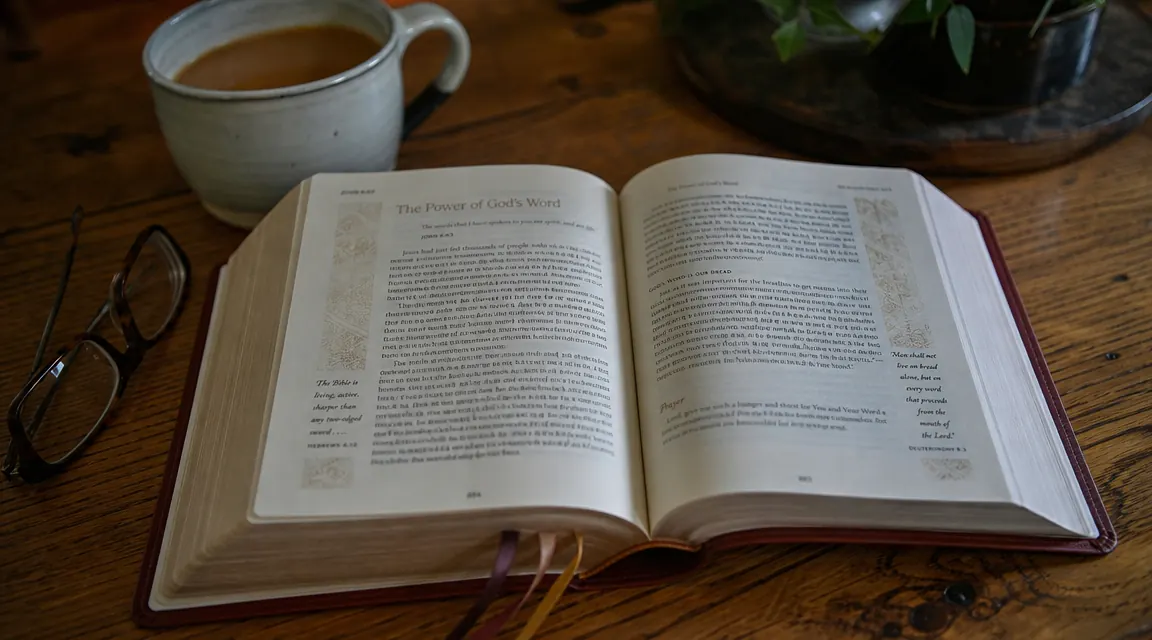
The first time I handed someone a copy of Thomas Nelson's Jesus Calling from the gift shop shelf, I honestly did not know if I was recommending a devotional or a phenomenon. That was 2019. I have watched it sell steadily ever since, through lockdowns and loss and ordinary Tuesday mornings when a customer would come in looking for something to give a friend who was struggling and not quite ready to say why. I started keeping my own copy on my kitchen table in the fall of that year, reading it each morning before anyone else in the house was awake. Five years later, the padded cover is soft from handling, the ribbon bookmark has frayed just slightly at the tip, and I have a pretty clear picture of what this book actually does over time.
This review covers the long haul. Not just the first-week novelty or the January resolution phase, but what it is like to live with a daily devotional through multiple seasons of life. I will be honest about the format quirks that wear differently after year three than they do in month one, about the Thomas Nelson binding, about who tends to stick with it and who quietly sets it aside.
The Quick Verdict
The warmest, most accessible daily devotional I know of. Sarah Young's first-person voice carries enormous comfort in hard seasons and remains readable after years of repetition. The theological question around its format is real but answerable. Most gift recipients keep it for life.
Amazon Check Today's Price →You have five minutes before the house wakes up. This is what to do with them.
Jesus Calling is the devotional I reach for when I need grounding, not information. Each entry is short enough to read before the coffee finishes brewing. Thomas Nelson's padded hardcover edition holds up to years of daily handling better than any paperback alternative I have tried.
Amazon Check Today's Price on Amazon →How I Have Used It
My routine has been simple and unchanged: I read the day's entry before breakfast, usually at the kitchen table while the coffee is still hot enough to burn my tongue. Each entry in Thomas Nelson's Jesus Calling runs roughly one page. Sarah Young writes in the first person as if God is speaking directly to the reader, drawing on scripture passages listed at the bottom of each entry. The format produces something closer to a centering prayer than a teaching, which is part of why it lands so differently from a study-oriented devotional.
I have gone through the book sequentially, cover to cover, and then started again the following January. I have also gone non-linearly, opening to whatever date felt right when I was processing something specific. Both approaches work. The entries do not build on each other the way a teaching series would, so there is no penalty for reading out of order. That flexibility matters more than it sounds on paper. Life rarely moves in tidy January-to-December arcs.
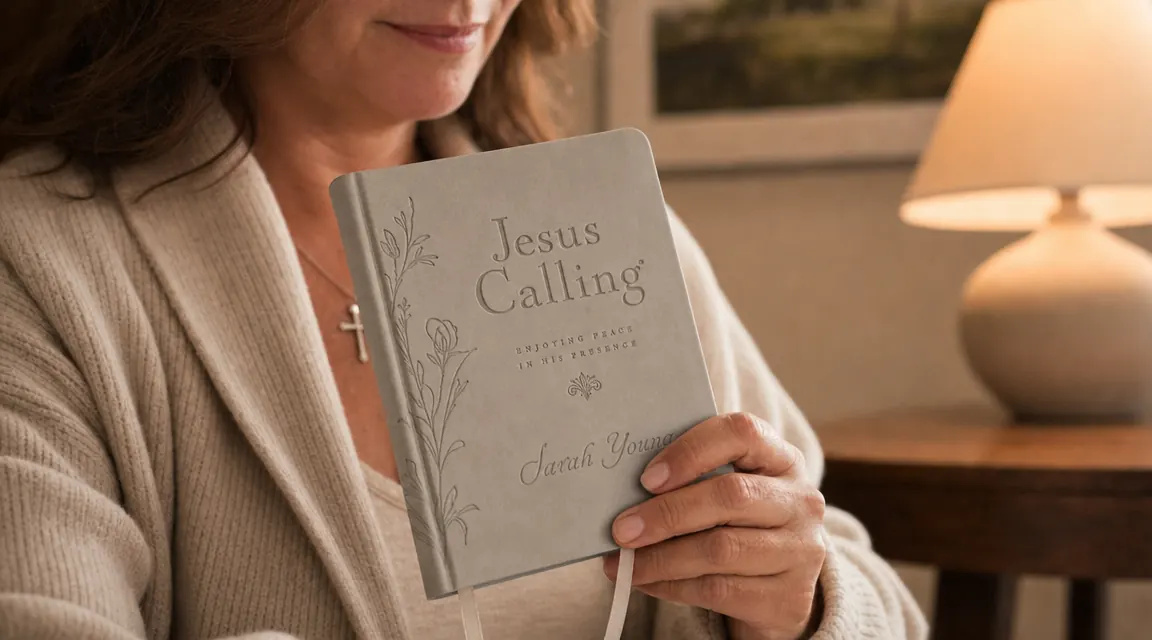
The padded hardcover edition is the one I recommend from the shop, for the same reason I recommend a good binding in any book meant to be handled every day for years. The soft cover feels good in the hand. It does not crack across the spine the way a rigid hardcover or a mass market paperback would. After five years mine shows honest wear at the corners, which I consider a mark of use rather than a flaw.
What the First-Person Format Actually Does Over Time
The theological question about Jesus Calling is the same one it has always attracted: is it appropriate to write devotional content in the voice of God speaking to the reader? Sarah Young addresses this directly in her introduction. She is not claiming to have received new scripture or private revelation. She describes these entries as reflections that arose from her own scripture reading and prayer, written in a devotional voice to help the reader feel addressed personally by God rather than merely reading about him. She is clear that her words carry no authority equal to scripture.
That context matters for long-term use, because the format that feels intimate in month one can raise a quiet unease in year three if you have not thought through its intent. My experience has been that readers who come to the book with a basic understanding of what Young is doing, and who treat it as a meditative companion to their scripture reading rather than a substitute for it, tend to stay with it. Readers who pick it up cold and never read the introduction are the ones who sometimes come back to the shop troubled by the format.
Over five years, I have found that the first-person voice produces a particular kind of reading experience that other formats do not replicate. It quiets the analytical faculty and invites the reader into something closer to prayer. On mornings when I cannot settle my mind enough to do meaningful scripture study, Jesus Calling often functions as a doorway back in. That is not a small thing.
On mornings when I cannot settle my mind enough to do meaningful scripture study, Jesus Calling often functions as a doorway back in. That is not a small thing.
The Seasons It Carried Me Through
In the winter of 2021, my mother was in hospice care for eleven weeks. I was driving two hours each way twice a week, sleeping badly, making decisions nobody wants to make. I read Jesus Calling every single morning during those weeks. I could not have absorbed a teaching. I could barely absorb a psalm. But I could take in one page written in a voice that said, essentially, I see you, I am here, be still. The entries for January and February of that year are the ones I know almost by heart now, because I read them when I had nothing left to give the day.
That is not the only season, just the sharpest one. I have also brought it to a stretch of ordinary contentment in the summer of 2022 when nothing was particularly hard but I wanted to stay tethered to something other than the noise of the day. It worked differently in that season, more like maintenance than rescue. The book does not require crisis to be useful. It adapts to wherever the reader is, which is a quality I have come to think of as one of its core strengths.
Several customers in the shop have told me similar things. A woman who lost her husband in 2020 came in to buy a third copy last spring because her first two had worn out and been given away to people who needed them. A Sunday School director has bought it in bulk as a graduation gift for high school seniors three years running. The through-line in every story is that the book traveled with the person rather than sitting on a shelf waiting to be discovered.

How the Writing Wears Over Years
Reading the same 365 entries multiple times surfaces something worth naming: Young's writing is more consistent than it is varied. The entries follow a recognizable emotional arc. There is almost always an acknowledgment of difficulty or distraction at the start, a turn toward God's presence, and a closing invitation to trust or rest. After several cycles through the book, you begin to anticipate the shape of each entry before you read it.
I do not mean that as a criticism, exactly. Liturgy is built on repetition for a reason. The Anglican Morning Prayer I grew up with has the same bones every morning, and the familiarity is part of what makes it grounding. But it is worth knowing before you begin, especially if you are someone who reads primarily for intellectual stimulation or expects a devotional to teach you new things each year. Jesus Calling will not teach you new things each year. It will offer the same invitation in slightly different clothing, and depending on your temperament, that will be exactly what you need or it will eventually feel thin.
The scripture references at the bottom of each entry are genuinely useful and often where I find the real nourishment. Young typically cites three to five passages. Following those references into your Bible adds the depth that the entry itself cannot carry. If I were to give one piece of advice to a new Jesus Calling reader, it would be to keep a Bible on the same table and look up at least one reference each morning. The combination works considerably better than the devotional alone.
The Physical Book: Binding, Paper, and Five Years of Handling
The padded hardcover is the edition I keep coming back to for gift recommendations, and my own copy has given me a detailed picture of how it holds up. The cover padding is substantial, not token. It is stitched at the edges rather than glued, which matters for durability. After five years of daily handling, the padding has compressed slightly at the top corner where I most often pick it up, but it has not cracked or separated.
The paper is cream-toned rather than stark white, which makes extended reading easier on the eyes in morning light. The font is large enough to read without glasses in good light, though readers who already need readers for fine print will want good lighting. The ribbon bookmark, a detail I appreciate in any devotional or Bible, is sewn securely. Mine has frayed about a quarter inch at the tip after five years, which is honest wear, not poor craftsmanship.
The spine has held without cracking even through repeated opening to the same pages. That is where cheaper devotionals tend to fail. If you are recommending this as a gift that someone will actually use daily for years, the padded hardcover edition is the right choice. The paperback version is less expensive but will not hold up to the same handling.
What I Liked
- The first-person devotional format creates genuine emotional intimacy, particularly valuable in grief or anxiety
- Entry length is perfectly calibrated for a daily habit: long enough to be meaningful, short enough to complete in five minutes
- The padded hardcover binding holds up to years of daily use without spine cracking or cover separation
- Works in any season, not just crisis moments, and reads differently depending on what the reader brings to it
- Scripture references at the bottom of each entry are a genuine resource, not decorative filler
- 40,000-plus reader reviews at 4.9 stars reflects real, sustained usefulness across a wide range of people and circumstances
Where It Falls Short
- The repetitive emotional arc of each entry becomes more noticeable after multiple cycles through the book
- Readers who want intellectual depth or theological teaching will find it too thin on its own
- The first-person voice format requires that readers read Young's introduction to avoid misunderstanding the intent
- Those who need variety to sustain a daily habit may want to rotate it with a more teaching-oriented devotional
Who This Is For
Jesus Calling is best suited for readers who are going through something hard, starting a daily devotional habit for the first time, or looking for a gentle and accessible way back into regular prayer after a season of distance. It is also an excellent gift for someone who does not yet know what they need but is clearly in a season of searching. The format does not assume theological background. It assumes only that the reader wants to feel less alone in their day.
It is the devotional I most often recommend for mothers with young children who have only five minutes of quiet, for people in grief who cannot absorb much information at once, and for adults who are returning to faith after years away. It meets people where they are without requiring them to already be somewhere else. That accessibility is genuinely rare.
Who Should Skip It
If you are a theologically trained reader or someone who reads devotionals primarily for doctrinal content, Jesus Calling will not satisfy you as a standalone practice. It is not designed to teach scripture systematically, address denominational questions, or carry the load of a serious Bible study. Pairing it with a stronger study resource is straightforward, but if you want depth from a single volume, you would be better served by something like Oswald Chambers. I cover that comparison in more detail in my review of Jesus Calling versus My Utmost for His Highest, which is worth reading before you decide.
I would also be honest with readers who struggle to sit with repetition. If you are someone who needs novelty to stay engaged, the second cycle through the book will feel slower than the first. That is not a flaw in the book; it is information about your reading temperament. Knowing it in advance helps you set realistic expectations or plan to rotate devotionals to keep the habit fresh.
Those who want to build a lasting daily devotional practice will find a practical framework in my piece on building a devotional habit that actually sticks, which covers scheduling, pairing, and what to do when you fall behind. Jesus Calling is the devotional I recommend to anchor that practice.
Five years in, I still reach for this book on the hardest mornings.
If you are looking for a devotional that will travel with someone through an ordinary year and through the seasons that are anything but ordinary, this is the one I would put in your hands. The padded hardcover edition holds up to daily use in a way the paperback does not. Check current pricing on Amazon before buying, since Thomas Nelson runs promotions throughout the year.
Amazon Check Today's Price on Amazon →