

If you have been standing in front of a Bible display, or staring at two browser tabs, trying to decide between the ESV Study Bible and the NIV Study Bible, you are not overthinking it. This is actually a meaningful choice. Both are excellent. Both are serious study resources from reputable Christian publishers. And they are different enough that picking the wrong one for the wrong person is a real possibility. Let me walk you through the comparison the way I would if you had pulled me aside in the gift shop.
The short answer: if you are buying for someone who wants to dig deeply into the theological and historical layers of scripture, particularly someone in a Reformed or broadly evangelical tradition who reads seriously, the ESV Study Bible is the stronger pick. If you are buying for a newer believer, a teenager, or someone who finds the King James-adjacent rhythms of older translations a barrier, the NIV Study Bible meets them where they are with warmer, more contemporary English. The longer answer is below.
| Feature | ESV Study Bible (Crossway) | NIV Study Bible (Zondervan) |
|---|---|---|
| Publisher | Crossway | Zondervan |
| Translation style | Essentially literal (word-for-word closer) | Dynamic equivalence (thought-for-thought closer) |
| Study note pages | Approx. 1,250 pages of notes and resources | Approx. 900 pages of notes and resources |
| Total article count | 240+ articles, introductions, and essays | Approx. 125 articles and introductions |
| Maps and illustrations | 240 full-color maps and charts | Approx. 80 maps and charts |
| Reading level | Grade 8-10 (more formal English) | Grade 6-8 (more conversational English) |
| Theological lean | Broadly Reformed/Calvinist (transparent about it) | Broadly evangelical (theologically open) |
| Physical weight | Approx. 4.5 lbs (hardcover) | Approx. 3.5 lbs (hardcover) |
| Best for | Deep study, seminary students, serious readers | New believers, teens, casual daily readers |
| Available on Amazon | Yes, with prime shipping | Yes, with prime shipping |
Where the ESV Study Bible Wins
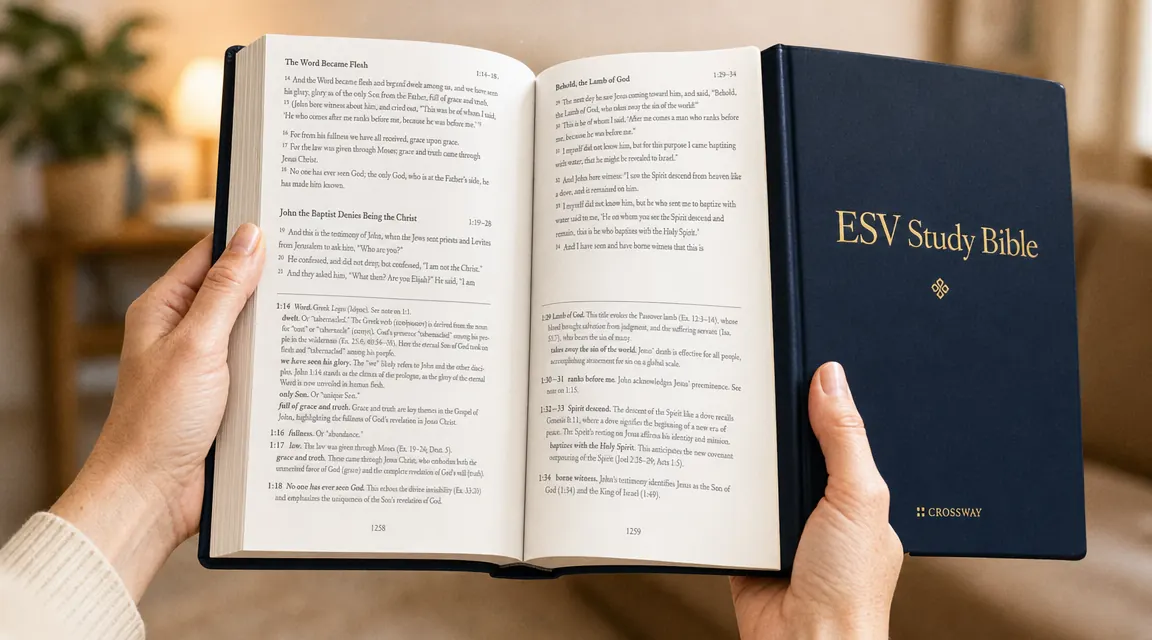
The ESV Study Bible, published by Crossway in 2008, is widely considered the most exhaustive single-volume study Bible available in any translation. That is not a marketing claim. It is the assessment of seminary professors, pastors, and Bible teachers who have compared resources for decades. The footnotes alone run to roughly 1,250 pages. To put that in perspective, many complete Bibles are shorter than the study apparatus in this one volume. When you open a page in Hebrews or Romans, you can expect to find two or three paragraphs of explanation below the text, cross-references in the margins, and a chain of related essays just a few pages away. For someone who wants to understand not just what a passage says but why it says it, where it fits in the sweep of redemptive history, and what the original Greek or Hebrew word carried in its first-century context, there is no comparable resource at this price point.
The 240 full-color maps and charts are the other standout feature. I have seen Bible study groups spend entire sessions on a single ESV map, tracing Paul's missionary journeys with their fingers, arguing cheerfully about which city he might have visited first. The visual scaffolding makes the ancient world feel real in a way that text alone cannot accomplish. If the person you are buying for has ever said something like, 'I wish I understood the geography better,' or 'I never know who the kings are in relation to each other,' the ESV Study Bible's charts answer those questions before the reader even thinks to ask them.
Where the NIV Study Bible Wins
The NIV has been the best-selling modern translation in the English-speaking world for decades, and the NIV Study Bible leverages that readability advantage well. The translation itself reads more naturally to contemporary ears. Sentences flow closer to how a careful writer today would express the same idea, rather than following the grammatical structure of Greek or Hebrew. For a new believer who already feels intimidated by scripture, or a teenager who is picking up a Bible for the first time and needs it to feel approachable rather than archaic, that matters more than anything else. A Bible that a person actually reads is better than a Bible that sits on the shelf because it feels like homework.
The NIV Study Bible's notes are also written at a slightly more accessible level. They explain context and meaning without assuming the reader already knows what a covenant is or why the tabernacle dimensions matter. The theological range of its contributing scholars is somewhat broader, which can feel like a feature if the recipient holds views that sit outside a Reformed framework. The lighter physical weight is a genuine practical advantage too. The ESV Study Bible is a beautiful object, but at roughly four and a half pounds it is not a Bible you slip into a tote bag for a women's retreat. The NIV Study Bible is meaningfully easier to carry.
The ESV Study Bible is the deeper resource for the serious student in your life.
Over 10,400 verified reviews. More than 1,250 pages of notes, 240 full-color maps, and 240 articles. Published by Crossway. Ships fast with Amazon Prime.
Amazon Check Today's Price on Amazon →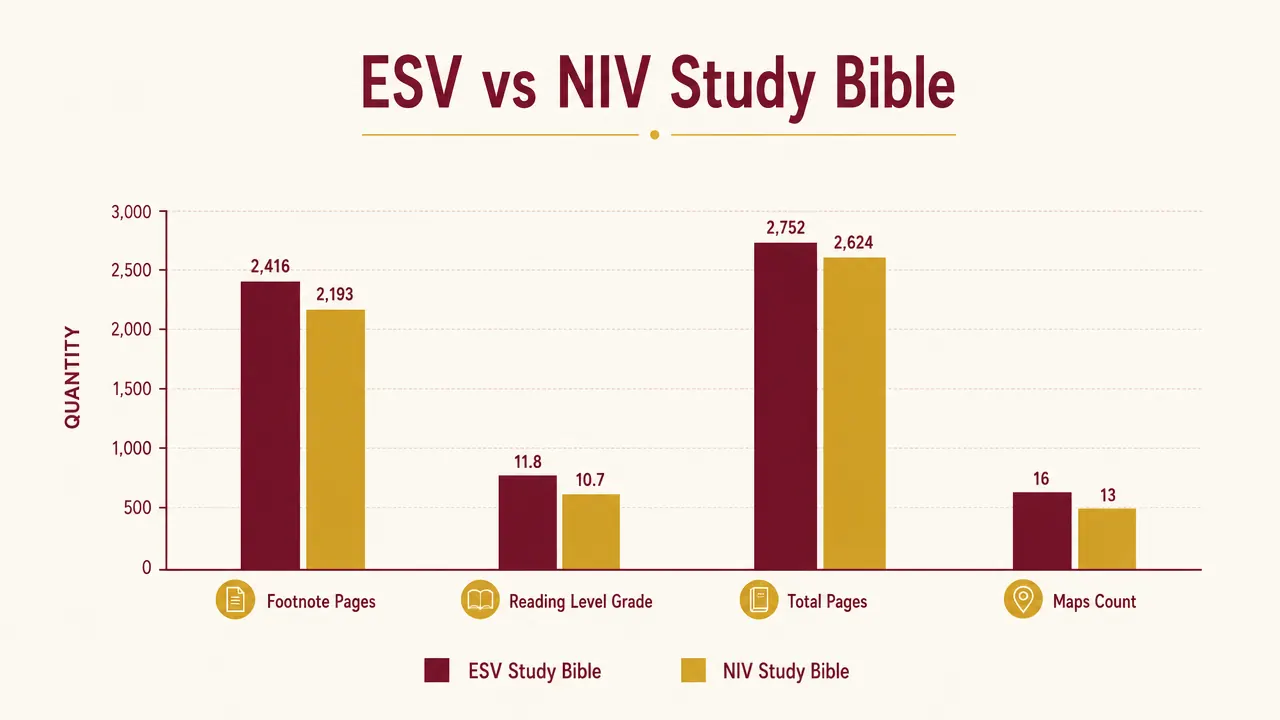
The Translation Difference: Why It Matters More Than People Think
People sometimes wave off the translation question with a 'they all say the same thing' dismissal. At the level of the gospel, that is true. At the level of serious Bible study, it is not quite right. The ESV is what scholars call an essentially literal translation, meaning it tries to preserve the word-for-word structure of the original Greek and Hebrew as much as English grammar allows. The NIV is a dynamic equivalence translation, meaning it aims to reproduce the thought or meaning rather than the word. Both approaches have legitimate scholarly defenders. The practical difference is that the ESV will sometimes produce a sentence that feels slightly formal or even wooden, because it is tracking the original syntax. The NIV will produce a sentence that flows more naturally, because it has made choices about meaning that the reader does not have to make.
For most gift recipients, this difference comes down to one question: do they already have a translation they love and use for preaching or group study? If their church uses the ESV from the pulpit, give them the ESV Study Bible. The in-sermon cross-referencing alone will make it worth having. If their church uses the NIV, or if they do not yet have a church preference, either can work. But for the gift-giver who wants to give the more comprehensive scholarly resource regardless of translation preference, the ESV Study Bible is the one with more underneath the hood.
A Bible that a person actually reads is better than a Bible that sits on the shelf because it feels like homework. Know your recipient first, and the choice becomes obvious.
The Theological Lean: Addressing It Honestly
I want to address this plainly because I have seen gift-givers caught off guard by it. The ESV Study Bible's study notes were produced primarily by scholars in the Reformed tradition, including people like John Piper, D. A. Carson, and Wayne Grudem. Crossway is transparent about this. The notes reflect a Calvinist understanding of election, grace, and divine sovereignty. If the person you are buying for is a committed Arminian, or attends a Wesleyan, Pentecostal, or broadly charismatic congregation, they may read some of the notes on passages like Romans 8 or John 6 and feel that the notes are presenting one theological interpretation as settled fact. That does not make the notes wrong. It makes them the product of a particular tradition.
The NIV Study Bible draws from a broader pool of evangelical scholarship and is less theologically pointed on those contested passages. For a gift recipient whose church tradition leans Arminian or open, the NIV Study Bible's notes will feel more like the commentary of a wise pastor than like a position paper. Neither of these is a flaw. They are just different tools for different households. If you are not sure where the recipient lands on that spectrum, and they attend a broadly evangelical church, either resource will serve them well. If they are confessionally Reformed, the ESV Study Bible was practically written for them.

Who Should Buy Which
The ESV Study Bible is the right call when you are buying for: a pastor, seminary student, small-group leader, or lay elder who wants the most comprehensive single-volume study resource available. It is also the right call for a serious reader in a Reformed or broadly evangelical tradition who has been using a plain Bible for years and is ready for something that will take their study deeper. It is a meaningful gift for a retirement, an ordination, a confirmation for a young adult who has already demonstrated serious interest in scripture, or a milestone birthday for someone you know reads their Bible every day.
The NIV Study Bible is the right call when you are buying for: a new believer who is just beginning to read scripture regularly. A teenager who has expressed interest in faith but is not yet a committed daily reader. Someone who reads primarily for devotional encouragement rather than theological depth. Someone whose church tradition sits outside the Reformed stream and who might find heavily Calvinist notes jarring on certain passages. If your recipient said something like, 'I want to understand the Bible better but I do not know where to start,' the NIV Study Bible is probably the gentler on-ramp.
A Note on Physical Size and Gifting Practicalities
Both of these Bibles are large. Neither is a travel Bible. The ESV Study Bible in standard hardcover weighs close to four and a half pounds and is over two inches thick. It is meant to live on a desk or a nightstand, not travel in a purse. The NIV Study Bible is slightly lighter and thinner, which gives it a small practical advantage for people who carry their Bible to church each week or to a weekly small group. If the person you are buying for already has a pew Bible at their church and wants a study resource primarily for home use, the ESV Study Bible's extra depth justifies its extra weight. If they carry their Bible regularly, factor that in.
Both Bibles are available in multiple bindings, including bonded leather and genuine leather editions that add to the gift presentation considerably. The leather editions are worth considering for a milestone gift where you want the physical object to feel as meaningful as the contents. For a standard gift, the hardcover edition is sturdy and presents beautifully wrapped in brown kraft paper with a simple ribbon. I have given the ESV Study Bible as a retirement gift and a seminary graduation gift, and both times the recipient's face said it all before they had read a single note.
Ready to give the most comprehensive study Bible available? The ESV is waiting.
Crossway's ESV Study Bible carries a 4.8-star rating from over 10,400 buyers. It is the study Bible that seminary professors recommend and serious readers keep for a lifetime.
Amazon Check Today's Price on Amazon →