

Here is the truth about walking into a Christian bookstore to pick a study Bible for the first time: it is overwhelming in a way that nobody warns you about. You go in looking for one book and discover there are dozens of versions, translations, and editions, each with a different set of promises on the back cover. Word-for-word accuracy. Easy-to-understand language. Forty thousand notes. Ten thousand notes. Red-letter text. No-red-letter text. Leather. Bonded leather. Imitation leather. TruTone. By the time you reach the checkout, your brain hurts and you are not entirely sure you made the right call.
I spent fifteen years behind the counter of our church gift shop before I started writing for The Faith List, and the single most common thing I heard from new believers and gift-givers alike was some version of: 'I just did not know where to start.' This guide is what I wish I could have handed every one of them. Five clear decisions, in the order they actually matter, and one honest recommendation at the end for anyone who wants to skip straight to the answer.
Already know you want the best-reviewed study Bible for first-time readers? Check current availability.
The ESV Study Bible by Crossway is the most comprehensive first study Bible available, with over 10,400 reviews averaging 4.8 stars. It covers every book with in-depth notes, maps, and cross-references that actually explain what you are reading.
Amazon Check Today's Price on Amazon →Step 1: Pick a Translation That Matches How You Read
Before you think about notes or binding, get the translation right. Every study Bible is built on a specific English translation, and if the language does not feel natural to you, you will use the Bible less. It is that simple.
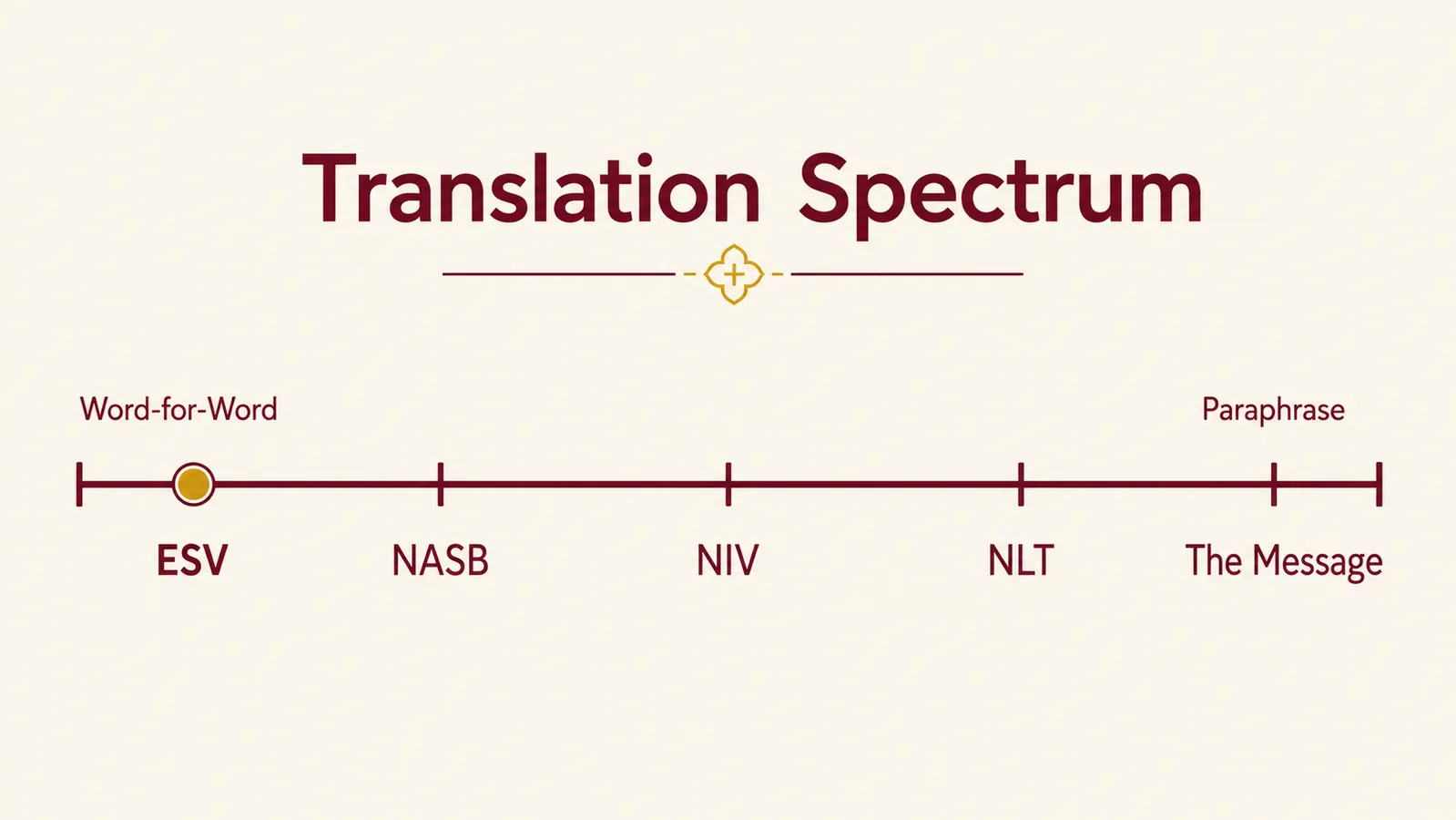
Translations fall on a spectrum from word-for-word (formal equivalence) to thought-for-thought (dynamic equivalence) to paraphrase. On the word-for-word end you have the ESV (English Standard Version) and the NASB (New American Standard Bible). These stay as close to the original Hebrew and Greek as readable English allows. In the middle you have the NIV (New International Version), which balances accuracy with everyday readability. Further toward thought-for-thought is the NLT (New Living Translation), which is a strong choice for people who find older-style Bible English hard to track. The Message is a full paraphrase and reads like a novel, which makes it good for devotional reading but not ideal as your primary study text.
For a first study Bible, I point most people toward either the ESV or the NIV. Both have strong scholarly study editions behind them, both are widely used in churches across denominations, and both give you language you can actually look up in sermons and small-group discussions. If you are buying for a child or a brand-new reader, the NLT is worth considering. If you are buying for yourself and you want something you can dig into deeply for years, go with the ESV.
Step 2: Decide How Deep You Want the Study Notes
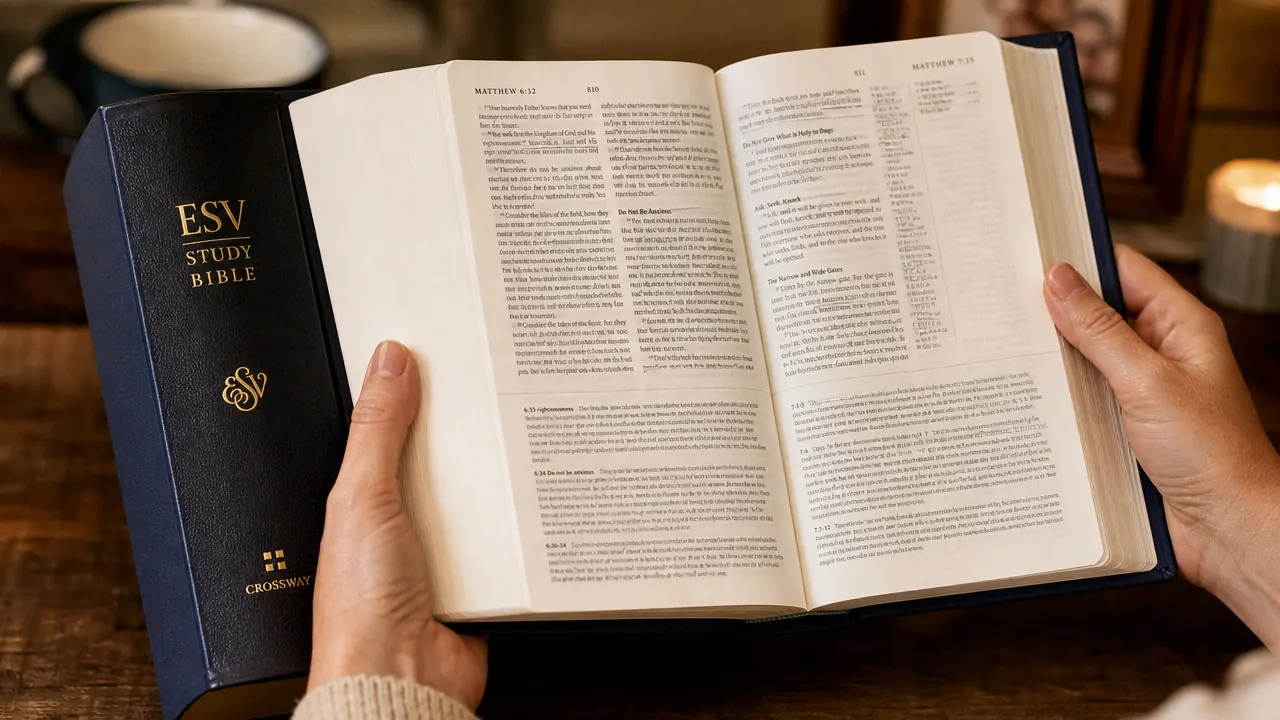
Study notes are the features that turn a regular Bible into a study Bible. They are the commentary printed below or beside the scripture text, written by scholars to explain historical context, original language meaning, cross-references to other passages, and theological significance. The question is: how deep do you want to go?
Some study Bibles keep their notes brief, a sentence or two per passage, designed for daily reading without interruption. Others pack several paragraphs per page, with articles, maps, timelines, and thousands of cross-references. A brief-notes study Bible is lower friction for daily devotional use. A comprehensive-notes study Bible is a better long-term investment if you want to actually study scripture rather than just read it.
The ESV Study Bible sits firmly in the comprehensive category. It contains over 20,000 study notes, 80,000 cross-references, 200 full-color maps, and 50 thematic articles. That sounds like a lot, and it is. But the notes are written to be useful at multiple levels. You can read past them entirely if you are in a devotional rhythm, or you can stop and spend twenty minutes on a single passage with everything you need right on the page. That flexibility is why it works as both a beginner's Bible and a lifelong reference.
A study Bible is not a textbook you finish. It is a conversation partner you return to. The depth of the notes matters most when you are ready to go deeper, and a good study Bible meets you right there.
Step 3: Check the Cross-Reference System
Cross-references are the numbered or lettered superscripts in the text that point you to other passages using the same word, theme, or idea. They are one of the most underappreciated features in a study Bible, and one of the most powerful for actually understanding scripture.
When you read John 1:1 and a cross-reference points you to Genesis 1:1, you see the deliberate echo the author intended. When you read about Jesus describing himself as the bread of life in John 6 and a cross-reference points to the manna in Exodus 16, the whole story of God's provision snaps into focus in a way it simply cannot when you are reading a single passage in isolation. Scripture is self-interpreting, and cross-references are how a study Bible makes that visible on the page.
When evaluating any study Bible, look at two things: the volume of cross-references and how clearly they are laid out on the page. A dense system crammed into a small font is less usable than a well-spaced system with room to read. The ESV Study Bible's 80,000 cross-references are presented in a dedicated column in most editions, which keeps them accessible without cluttering the main text.

Step 4: Consider Font Size and Page Layout
This is the step most guides skip, and it is the one that will make or break your actual daily use. A study Bible is physically dense. It is a thick book packed with small text. If the font is too small for comfortable reading, you will find reasons not to open it, and no amount of excellent scholarship will change that.
Before buying, try to hold the Bible open to a regular text page and a notes page. Can you read both without squinting? Is the contrast between the scripture text and the notes text clear enough that you can navigate quickly? Are the headers and book names easy to scan? These details matter more at 10 p.m. by a bedside lamp than they do under bright store lighting. If you are buying online, look for reviews that specifically mention font size, or search the publisher's site for the exact point size listed in the product specifications.
For readers over fifty or anyone who spends long reading sessions with the Bible, I often recommend looking at large-print study editions. The ESV Study Bible is available in a large-print format that preserves all the notes and cross-references at a size that is genuinely comfortable for extended reading. The trade-off is that the book gets heavier and wider, which leads us to the next decision.
Step 5: Choose a Binding That Fits Your Actual Habits
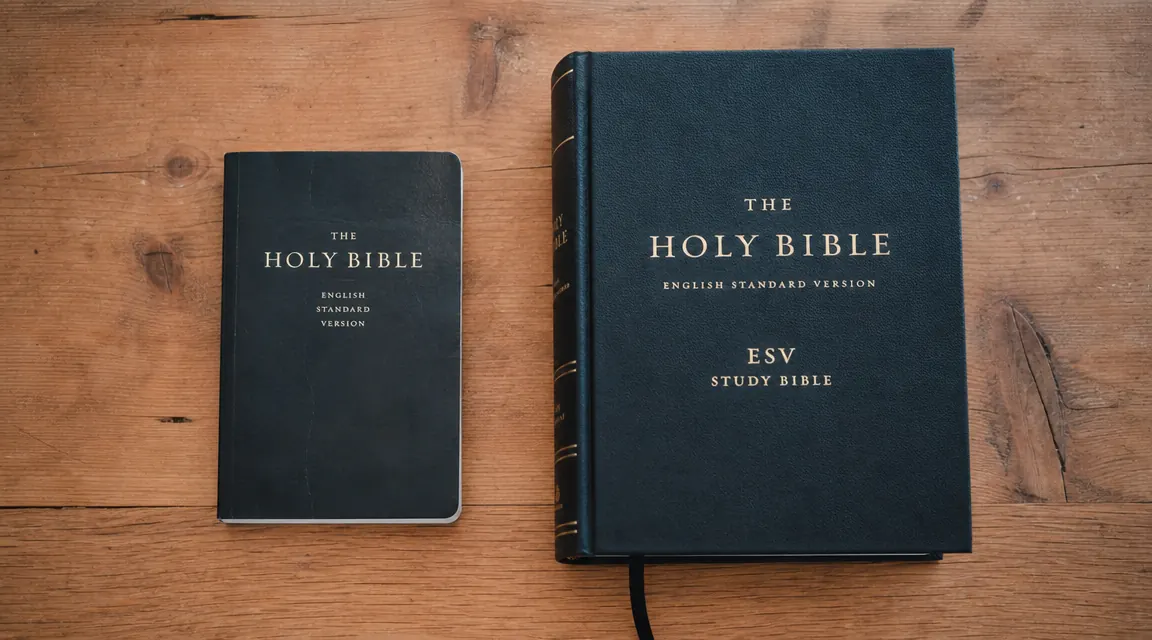
A study Bible is not a pocket Bible. Most comprehensive editions weigh between four and six pounds. The binding you choose affects how the book feels in your hands, whether it lies flat when open, and how long it holds up under daily use.
Here is a plain-talk breakdown of the most common options. Hardcover is the least expensive and the most durable for storage, but it does not flex or lie flat naturally. Bonded leather uses leather scraps pressed together, looks nice on day one, but can crack and peel over time with heavy use. Genuine leather is more expensive and ages with the book in a good way, developing a worn feel that most regular Bible readers love. TruTone is a synthetic material that mimics leather, holds up extremely well, and is a strong value pick for daily users who want flexibility without the cost of genuine leather. Goatskin is the premium option, used in heirloom and gift editions, and it is extraordinarily durable, but the price reflects it.
For a first study Bible that is going to be used regularly, I usually suggest TruTone or genuine leather. Both lie relatively flat when open, both hold up to years of handling, and both feel like a serious book rather than a mass-market paperback. If you are buying as a gift and presentation matters, the genuine leather or premium calfskin editions come with a quality that reads immediately when the recipient lifts the box lid.
What Else Helps: Small Decisions That Make a Big Difference
Beyond the five main decisions, a few smaller features are worth a quick check before you finalize any study Bible purchase. Ribbon markers, which are the fabric bookmarks sewn into the spine, are genuinely useful in a study Bible because you are often moving between multiple passages. Most quality editions include two or three. Look for that before you assume they are there.
Concordance is another feature worth noting. A concordance at the back of the Bible lets you search by word, which is handy when you remember a phrase from a verse but cannot remember where it is. Some study Bibles include a robust concordance; others omit it to save space and assume you will use a Bible app for word searches. If you are a paper-only reader, a built-in concordance is worth having.
Maps, full-color inserts, and timelines are the features that tend to get mentioned most in reviews, but they are the features I would worry least about. They are nice to have. They are not reasons to choose one study Bible over another if the translation, notes, and binding are not right. Focus on those first. The maps are a bonus.
My Top Pick for First-Time Study Bible Buyers
After fifteen years of watching women in our gift shop pick up study Bibles, thumb through them, set them down, and come back again, one edition consistently ended up at the checkout counter: the ESV Study Bible published by Crossway. It is the one I have given as a gift more times than I can count, and the one I still reach for when I need to settle a question about a passage I am teaching.
The ESV translation sits at the word-for-word end of the spectrum without sacrificing readable English. The notes are comprehensive without being academic to the point of inaccessibility. The cross-reference system is one of the most extensive available in any study Bible. And the physical editions, particularly the TruTone and genuine leather versions, hold up year after year without peeling or cracking in the way bonded leather eventually does. With 10,427 reviews averaging 4.8 stars, it is not a hidden gem. It is the standard recommendation for good reason.
If you have already done some reading about study Bibles, you may have seen the ESV Study Bible compared to the NIV Study Bible. Both are excellent. If you attend a church that primarily uses the NIV in services, the NIV Study Bible will feel more familiar during sermons. If your church uses the ESV or if translation fidelity to the original languages matters to you, the ESV Study Bible is the stronger pick. For a fuller comparison of the two, see the guide on ESV Study Bible vs NIV Study Bible. And if you want a deeper look at how three years of daily small-group use changed my view of the ESV Study Bible's notes, the long-term review covers everything I did not know to look for at the beginning.
The bottom line is this: a first study Bible is a ten-year decision, maybe longer. The ESV Study Bible is built for that kind of longevity. It does not try to be a devotional guide or a reader-friendly paraphrase. It is a scholarly, comprehensive, accessible study resource in a translation that the broader church has trusted for decades. For a new believer who wants to understand what they are reading, or for a gift-giver who wants to give something that will still be in use at the recipient's kitchen table a decade from now, it is the one I keep coming back to.
The study Bible that holds up for years, not just months. Check current availability on Amazon.
The ESV Study Bible by Crossway is the recommended first study Bible for new believers and a trusted long-term reference for experienced readers. Over 10,400 verified buyers, 4.8-star average. Available in multiple binding options including TruTone, genuine leather, and large print.
Amazon Check Today's Price on Amazon →